If you are considering a development project in Scotland, you may have come across the terms “planning permission” and “planning permission in principle”.
While they sound similar, they are two distinct types of planning application and are used for different purposes. Understanding the difference can help you decide which route may be most appropriate for your project.
Key Takeaway
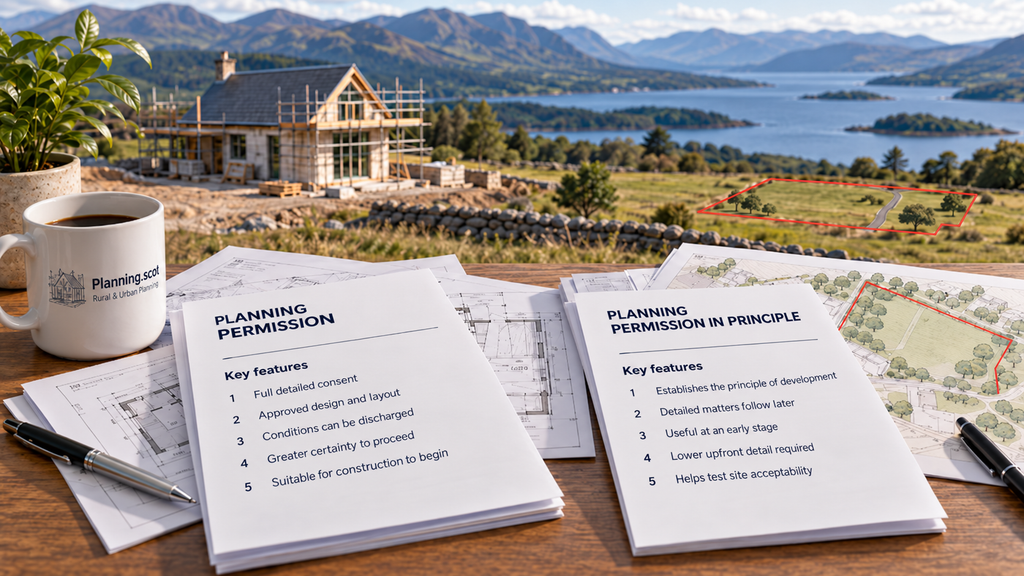
Planning permission is used when the details of a proposal have been fully developed. Planning permission in principle is used to establish whether development may be acceptable in principle before detailed designs are prepared.
What is Planning Permission?
Planning permission is the most common form of planning consent and is used where the details of a proposal have been fully developed.
An application for planning permission will normally include detailed plans, drawings and supporting information showing exactly what is proposed. The Planning Authority will assess these details against National Planning Framework 4 (NPF4), the relevant Local Development Plan and any other material considerations before determining whether permission should be granted.
Planning permission can be used for a wide variety of developments, including:
- New houses
- Residential developments
- Commercial and industrial developments
- Changes of use
- Renewable energy projects
- Infrastructure development
Householder planning applications also fall within this category. These are applications relating to existing homes and commonly include proposals such as:
- Extensions
- Garages
- Garden rooms and outbuildings
- Alterations to houses
- Boundary treatments and other domestic development
In most cases, if planning permission is granted, development can proceed once any pre-commencement planning conditions have been discharged and any other required consents have been obtained.
What is Planning Permission in Principle?
Planning permission in principle (often abbreviated to PIP or PPiP) is a different type of planning consent.
Rather than seeking approval for a fully detailed proposal, planning permission in principle is used to establish whether the principle of development is acceptable on a particular site.
This can be particularly useful where an applicant wishes to understand whether development may be supported before investing in detailed designs, technical surveys or architectural work.
Applications for planning permission in principle typically include less detailed information than a full planning application. The Planning Authority will focus primarily on whether the proposed use of the land is acceptable and whether there are any significant policy or site constraints that would prevent development.
What Happens After Planning Permission in Principle is Granted?
A common misconception is that planning permission in principle allows development to start immediately.
In reality, planning permission in principle is usually only the first stage of the process.
Before development can commence, the applicant will normally require to submit a further application known as an Application for Approval of Matters Specified in Conditions (AMSC or MSC).
This application provides the detailed information that was not considered at the planning permission in principle stage, such as:
- The siting of buildings
- Design and appearance
- Landscaping
- Access arrangements
- Drainage proposals
- Other detailed matters identified by the Planning Authority
The Planning Authority must approve these matters before development can lawfully begin.
For this reason, planning permission in principle should generally be viewed as establishing that development may be acceptable, rather than providing a final approval for the detailed proposal.
Which Route is Best?
The most appropriate route will depend on the nature of the project and how far it has progressed.
Planning permission may be the best option where:
- Detailed designs have already been prepared
- The proposal is relatively straightforward
- There is some certainty that the principle of development is acceptable
- The applicant wishes to obtain a final decision on a specific scheme
Planning permission in principle may be more appropriate where:
- The principle of development is uncertain
- A site is being explored for development potential
- The applicant wishes to minimise upfront costs before progressing detailed design work
Each approach has advantages and disadvantages, and the most suitable option will depend on the individual circumstances of the proposal.
What About Other Types of Consent?
Many people use the term “planning permission” to describe a range of development-related consents. However, several other consent regimes exist within Scotland’s planning system.
Examples include:
- Listed Building Consent
- Conservation Area Consent
- Advertisement Consent
- Hazardous Substances Consent
Although these applications are generally administered by the Planning Authority, they are separate legal processes with their own statutory requirements, assessment criteria and decision-making frameworks.
For example, Conservation Area Consent may be required for the total or substantial demolition of an unlisted building or structure within a conservation area, while Listed Building Consent is generally required for works affecting a listed building, including demolition.
Obtaining planning permission does not necessarily remove the need for other consents, and some projects may require multiple approvals before work can commence.
These types of consent will be explored in future articles.
Need Advice on a Planning Application?
At Planning.scot, we provide independent chartered town planning advice on development proposals across Scotland. Whether you are considering a house extension, a new dwelling, a rural development project or a larger commercial proposal, we can help identify the most appropriate application route and guide you through the planning process. Please contact us here.