When a planning application is submitted in Scotland, members of the public, community groups, businesses and other interested parties often have the opportunity to comment on the proposal.
These comments are commonly referred to as representations. Representations can support a proposal, object to it or simply provide information that the Planning Authority may wish to consider during its assessment.
While planning objections often receive the most attention, representations in support of a proposal can also be submitted and may form part of the Planning Authority’s assessment.
Understanding how representations work can help applicants, communities and interested parties engage more effectively with the planning process.
Key Takeaway
Anyone can make a representation on many planning applications and planning consultations in Scotland. Representations may support, object to or comment on a proposal and must be taken into account by the Planning Authority where they raise material planning considerations. However, the number of representations received does not automatically determine the outcome of an application.
What is a Planning Representation?
A representation is a written comment submitted to a Planning Authority in relation to a planning application or other planning proposal.
Representations can take several forms:
- Objections
- Letters of support
- General comments
- Responses from community councils
- Comments from businesses, organisations and public bodies
While objections are often the most visible type of representation, positive representations supporting a proposal can also be submitted.
Who Can Make a Representation?
Anyone can submit a representation on a planning application.
This includes:
- Neighbours
- Local residents
- Community councils
- Businesses
- Landowners
- Community groups
- Statutory consultees
- Other interested parties
There is no requirement to live next to a site or be directly affected by a proposal in order to submit comments, nor is there a requirement to live in Scotland or the wider United Kingdom.
However, the weight given to a representation will generally depend upon the planning issues raised rather than the identity of the person submitting it.
Are Representations Public?
In most cases, representations submitted to a Planning Authority form part of the public planning register and can be viewed by applicants, Planning Officers, elected members and other interested parties.
Representations are therefore generally not confidential and should not contain personal information that you would not wish to become publicly available.
While Planning Authorities will normally redact certain personal information before publishing representations online, the name of the person making the representation is often disclosed.
Anonymous representations are generally given little or no weight and many Planning Authorities will not accept anonymous comments as formal representations.
If you wish your views to be taken into account, it is normally necessary to provide your name and contact details when submitting a representation.
Petitions, Pro-Forma Responses and Round-Robin Letters
In some cases, individuals, community groups or campaign organisations may organise petitions, pro-forma responses or round-robin letters in support of or opposition to a proposal.
These can be a useful way of demonstrating the level of public interest in a development proposal and will generally be taken into account by the Planning Authority or Scottish Ministers as part of the decision-making process.
However, planning decisions are not determined by a vote and the number of signatures on a petition does not automatically determine the outcome of an application.
Similarly, where a large number of identical or near-identical representations are submitted, the Planning Authority may record and consider them collectively rather than assessing each submission separately.
In many cases, a petition containing hundreds of signatures or a large number of standardised responses may carry less weight than a smaller number of individually prepared representations that identify specific material planning considerations and explain how a proposal may affect particular interests or locations.
This does not mean that petitions and round-robin letters are unimportant. They can help demonstrate the extent of community support or opposition and may draw attention to planning issues that warrant further consideration. However, they are generally most effective when accompanied by clear planning arguments based on material planning considerations.
For this reason, individuals and community groups may wish to consider supplementing petitions or standardised responses with detailed representations that explain the planning issues they consider relevant to the proposal.
What Types of Applications Can Representations Be Made On?
Representations can be made on a wide range of planning-related applications and proposals where consultation procedures apply, including:
- Planning Permission applications
- Planning Permission in Principle applications
- Applications for Approval of Matters Specified in Conditions (AMSC)
- Listed Building Consent applications
- Conservation Area Consent applications
- Advertisement Consent applications
- Certain applications relating to hazardous substances
- Section 36 Electricity Act applications
- Section 37 Electricity Act applications
- Local Development Plan consultations
- Supplementary guidance consultations
- Other planning policy consultations
The opportunity to comment will vary depending on the type of application and the consultation procedures that apply.
Representations on Electricity Act Applications
Not all major energy developments are determined under the Town and Country Planning (Scotland) Act 1997.
Certain electricity generating stations, overhead electricity lines and related infrastructure may instead require consent under Sections 36 or 37 of the Electricity Act 1989.
These applications are generally determined by Scottish Ministers rather than the local Planning Authority, although the relevant Planning Authority is normally consulted and may provide formal comments on the proposal.
Members of the public, community councils, businesses and other interested parties are usually able to submit representations on such applications during the consultation period.
Representations can be an important part of the decision-making process and may influence how Scottish Ministers assess the environmental, planning and community impacts of a proposal.
Examples commonly include:
- Wind farms
- Hydro-electric developments
- Battery energy storage systems
- Overhead transmission lines
- Electricity substations and associated infrastructure
The consultation procedures for Electricity Act applications differ from those that apply to standard planning applications, but public participation remains an important part of the process.
What About Certificates of Lawfulness?
Unlike planning applications, there is generally no formal public consultation process for applications for a Certificate of Lawfulness.
This is because a Certificate of Lawfulness is not an application seeking planning permission. Instead, it is a legal determination as to whether a use or development is lawful based on the facts of the case and the relevant provisions of planning legislation.
As a result, neighbouring properties and other interested parties are not normally notified of Certificate of Lawfulness applications and there is no formal mechanism for the submission of representations or objections.
The Planning Authority’s role is not to assess the planning merits of the proposal or to balance competing views. Instead, it must determine whether the legal tests for granting a Certificate have been satisfied on the basis of the evidence provided.
Where a Certificate of Lawfulness is granted or refused, the applicant may have a right of appeal to Scottish Ministers through the Directorate for Planning and Environmental Appeals (DPEA).
How Long Do I Have to Submit a Representation?
The period for making representations will depend on the type of application and how it has been advertised.
For most planning applications, members of the public will normally have 21 days from the date of neighbour notification or public advertisement to submit comments.
However, consultation periods can vary depending on the circumstances of the application and the statutory procedures that apply.
Representations submitted after the consultation period may still be considered by the Planning Authority if a decision has not yet been issued, although there is generally no obligation to take late representations into account.
If you wish to comment on an application, it is always best to submit your representation as early as possible.
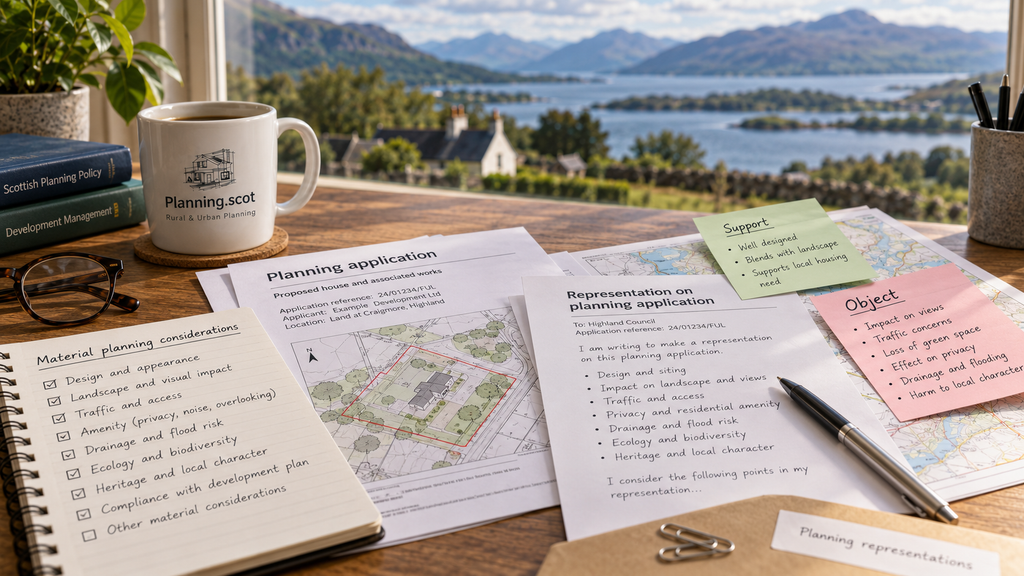
What Makes a Good Planning Objection?
The most effective objections focus on material planning considerations.
These are planning issues that the Planning Authority can lawfully take into account when determining an application.
Examples may include:
- Impact on residential amenity
- Traffic and road safety
- Design and appearance
- Landscape and visual impacts
- Biodiversity and ecology
- Flood risk and drainage
- Heritage impacts
- Noise and disturbance
- Development plan policies
- National Planning Framework 4 (NPF4)
The strongest representations are usually those supported by evidence and planning policy, rather than personal opinion alone.
You can read more about material planning considerations, including the types of issues that can be taken into account when determining planning applications and considering representations, in our dedicated article.
What Issues Cannot Normally Be Taken Into Account?
Some matters are generally not material planning considerations and are unlikely to influence the outcome of an application.
Examples commonly include:
- Loss of private views
- Impact on property values
- Personal disputes between neighbours
- Competition between businesses
- Moral objections
- Private legal matters such as title restrictions
While people are free to raise these issues, the Planning Authority will generally place little or no weight upon them when determining the application.
How Are Representations Considered?
Planning Officers are required to consider relevant representations received during the application process.
The number of objections or supporting comments does not automatically determine the outcome of an application.
A planning application is not decided by a vote.
Instead, the Planning Authority must assess:
- The development plan
- National Planning Framework 4 (NPF4)
- Other material considerations
- The planning merits of the proposal
- Relevant representations received
As a result, a proposal may be approved despite receiving objections, or refused despite receiving support.
The quality and relevance of the planning issues raised is generally more important than the number of representations received.
Can Representations Influence a Decision?
Yes.
Well-prepared representations can influence the outcome of a planning application.
They may:
- Identify planning issues that require further assessment
- Highlight relevant planning policies
- Draw attention to site constraints
- Prompt amendments to a proposal
- Influence planning conditions
- Contribute to a recommendation of approval or refusal
In some cases, representations can lead to significant changes being made to a development proposal before a decision is reached.
Can Representations Affect How an Application is Determined?
In some circumstances, representations can affect not only the assessment of an application but also the process by which it is determined.
Some Planning Authorities operate schemes of delegation that allow Planning Officers to determine certain applications under delegated powers. However, those schemes may contain provisions that require applications to be referred to a planning committee where a specified number of objections are received.
For example, at the time of writing, within The Highland Council area certain applications that receive six or more valid objections may require determination by the relevant planning committee rather than by officers under delegated powers. Applicants and interested parties should always refer to the current Scheme of Delegation, as thresholds and procedures can change.
The exact arrangements vary between Planning Authorities and are set out within each authority’s Scheme of Delegation.
It is important to note that referral to committee does not mean that an application will be approved or refused. The application must still be assessed against the development plan, National Planning Framework 4 (NPF4) and other material considerations.
Applicants and interested parties should be aware that committee referral thresholds and delegation arrangements vary between Planning Authorities and may change over time. The current position is normally set out within the relevant Planning Authority’s Scheme of Delegation. As a result, the number of representations required to trigger committee consideration in one area may differ from the arrangements that apply elsewhere in Scotland.
Representations on Development Plans
Representations are not limited to planning applications.
Members of the public, community groups, businesses and landowners can also submit representations on:
- Local Development Plans
- Development plan examinations
- Supplementary guidance
- Planning policy consultations
- National planning consultations
These representations can influence how planning policy evolves and may have long-term implications for future development opportunities.
Need Advice on a Planning Objection or Representation?
At Planning.scot, we prepare professional planning objections, representations and consultation responses on behalf of individuals, community groups, businesses and landowners across Scotland.
Whether you wish to support or object to a planning application, respond to a development plan consultation, comment on a Section 36 or Section 37 Electricity Act application or require assistance identifying relevant planning policies and material considerations, we can help prepare a robust and well-reasoned submission to the Planning Authority or Scottish Ministers.
You can contact us here for further help and guidance.